Saturday, January 14, 2012
Jan 14 - US Olympic Marathon Trials - YOUSER!!
So - today in Houston, the elite of the elite are racing for the three coveted spots on the 2012 US Olympic Team.
There are 2 front runners: Ryan Hall [men](great vid of Ryan nailing a tempo run) and Desi Davila [women]: women's contenders - but a host of others as well: 2012 US Marathon Trials!
Me? I hoping to see Dathan Ritz and Meb K nail a spot, and Shalan and Kara grab spots for the women...
and you can watch on NBC at 3pm EST.
This will be a rippin' good race - flat, fast and wickedly fun to watch.
Enjoy.
Now I am heading out the door for a run - too bad it is -20 and really windy. Frig - winter just roared in [fml].
peace out
Wednesday, January 4, 2012
2012 - I'mmmmm Baaaackk
So, 2012.
To state the fundamentally obvious, I took an extended break from the "blog world" while I focused on preparing for - and racing (sort of...) the Scotiabank Marathon in October, 2011.
I say "sort of" as the race, like life, did not go as planned. I could go into excruciating detail about "the good, the bad and the ugly" of the race (stupid hip flexor), but, suffice it to say, while I nailed a spot for Boston, I was wayyy off my goal for the race. WAY. OFF.
In fact, the best way to sum up the debacle of my race is to look back at what I wrote in my log book after:
"As I fell apart today, all I can say is "pride goeth before the fall" (or perhaps it was better said by Maverick's Commanding officer in "Top Gun": "son, your ego is writing cheques that your body can't cash" Top Gun - the best damn movie from the 80's)"
In a brighter note, there are now 2 Canadians who have run under the Canadian marathon standard of 2:11:29, and several - including my old friend Matt Loseille (and Simon Bairu, who is racing for a spot in Houston at the Chevron Marathon on January 13, 2012) have a really good shot at nailing a spot as well; and, the USA Marathon Trials on Jan 12 is sure to be a great day for running.
'nuff said for now - enjoy 2012.
peace out.
To state the fundamentally obvious, I took an extended break from the "blog world" while I focused on preparing for - and racing (sort of...) the Scotiabank Marathon in October, 2011.
I say "sort of" as the race, like life, did not go as planned. I could go into excruciating detail about "the good, the bad and the ugly" of the race (stupid hip flexor), but, suffice it to say, while I nailed a spot for Boston, I was wayyy off my goal for the race. WAY. OFF.
In fact, the best way to sum up the debacle of my race is to look back at what I wrote in my log book after:
"As I fell apart today, all I can say is "pride goeth before the fall" (or perhaps it was better said by Maverick's Commanding officer in "Top Gun": "son, your ego is writing cheques that your body can't cash" Top Gun - the best damn movie from the 80's)"
'nuff said for now - enjoy 2012.
peace out.
Monday, September 5, 2011
Sports Medicine: Hope or Hype?
As Sports Medicine Surges, Hope and Hype Outpace Proven Treatments
Until she tore her hamstring a year and a half ago, Tina Basle ran marathons. Since then, she has been on a desperate search for a cure.
It took her from doctor to doctor, cost her thousands of dollars and led her to try nearly everything sports medicine has to offer — an M.R.I. to show the extent of the injury, physical therapy that included ultrasound and laser therapy, strength training, an injection of platelet-rich plasma (or P.R.P.), a cortisone shot, another cortisone shot.
Finally, in February, she gave up.
“I decided this is never going to heal, so let’s get on with it,” she said.
And so Ms. Basle, a 44-year-old digital media consultant who lives in Manhattan, started running anyway. She has lost a lot of speed and endurance. And, she added, “the stupid hamstring is really no better.”
Medical experts say her tale of multiple futile treatments is all too familiar and points to growing problems in sports medicine, a medical subspecialty that has been experiencing explosive growth. Part of the field’s popularity, among patients and doctors alike, stems from the fact that celebrity athletes, desperate to get back to playing after an injury, have been trying unproven treatments, giving the procedures a sort of star appeal.
But now researchers are questioning many of the procedures, including new ones that often have no rigorous studies to back them up. “Everyone wants to get into sports medicine,” said Dr. James Andrews, a sports medicine orthopedist in Gulf Breeze, Fla., and president-elect of the American Orthopaedic Society for Sports Medicine.
Doctors love the specialty and can join it with as little as a year of training after their residency, as compared with the more typical two to four years for other specialty training. They see a large group of patients eager for treatment, ranging from competitive athletes to casual exercisers to retirees spending their time on the golf course or tennis court.
The problem is that most sports injuries, including tears of the hamstring ligament like Ms. Basle’s, have no established treatments.
Of course, some remedies for certain injuries do work: putting a cast on a broken bone or operating to repair a torn Achilles tendon. But patients whose injuries have no effective treatment often do not know that medicine has nothing to offer. And many expect cures.
“They watch ‘Grey’s Anatomy’ and think we can do anything,” said Dr. Raymond Monto, a sports medicine orthopedist in West Tisbury, Mass. “And to a certain extent, we allow that.”
Added to that is the effect of sports stars and their doctors. Patients “see a high-profile athlete and say, ‘I want you to do it exactly the same way their doctor did it,’ ” said Dr. Edward McDevitt, an orthopedist in Arnold, Md., who specializes in sports medicine.
The result is therapies that are unproven, possibly worthless or even harmful. There is surgery, like a popular operation that shaves the hip bone to prevent arthritis, that may not work. There are treatments, like steroid injections for injured tendons or taping a sprained ankle, that can slow the healing process. And there are fads, like one of Ms. Basle’s treatments, P.R.P., that soar in popularity while experts debate whether they help.
All this leads Dr. Andrew Green, a shoulder orthopedist at Brown University, to ask, “Is sports medicine a science, something that really pays attention to evidence? Or is it a boutique industry where you have a product and sell it?”
“For a lot of people it is a boutique business,” he said. “But are you still a doctor if you do that?”
A Theory Becomes a Fad
If ever anyone wanted to know how untested sports medicine treatments come into use, they would need only look at platelet-rich plasma, medical experts say. They joke that it is the perfect example of what is a tried-and-true path to popularizing a new treatment. It is what Dr. John Bergfeld, an orthopedic sports medicine specialist at the Cleveland Clinic, calls the Orthopedic Triad: famous athlete, famous doctor, untested treatment.
While there are no official statistics on P.R.P. treatment, all agree that it has exploded on the scene, propelled by testimonials from celebrity athletes.
Part of its appeal was that it made sense. Blood contains platelets that secrete growth factors that, in turn, can help tissue heal. So if a patient’s own platelets are injected into the injury site, they might speed recovery. And since it is the patient’s own platelets, the treatment is unlikely to be harmful.
It is easy to extract platelets. A doctor spins a tube of a patient’s blood in a centrifuge and then removes the middle layer of cells. Those are the platelets.
The claims by athletes and their doctors that brought the treatment to the fore began in the winter of 2009. Two leading football players for the Pittsburgh Steelers — Hines Ward, who sprained a ligament in his knee, and Troy Polamalu, who strained his calf — had P.R.P., recovered quickly and went on to play in the Super Bowl.
Earlier that year, a doctor for a pitcher for the Los Angeles Dodgers, Takashi Saito, said P.R.P. let the pitcher avoid surgery, which would have put him out of commission for about a year. Soon afterward, Tiger Woods reported that he had had four P.R.P. injections after knee surgery.
His doctor, Anthony Galea, who was later investigated for providing performance enhancing drugs to athletes, told The New York Times in December 2009 that within two days after his first treatment, Woods sent him a text. “He said he couldn’t believe how good he felt,” Dr. Galea said. “He’d joke and say, ‘I can jump on the kitchen table.’ ”
Having an athlete report that a treatment worked “is almost like direct-to-consumer advertising,” said Dr. Fred Azar, a sports medicine orthopedist in Memphis.
Of course, researchers say, testimonials from athletes and their doctors are a far cry from credible evidence. Most injuries eventually get better on their own, so if a patient has a treatment and then gets better, would the person have gotten better at the same time anyway? Or did the treatment actually slow the healing process? There is no way to know without a study that compares people who were randomly assigned to have a treatment with those who were randomly assigned not to have it.
But testimonials, especially from celebrities, had an effect.
Patients began asking for the treatment, and sports medicine doctors responded, offering it to speed healing of tissue and muscle injuries, mend broken bones and even help with arthritis.
(This reporter tried P.R.P. in 2009 for a torn hamstring and wrote in an article about the experience that it was impossible to know if it helped; her hamstring eventually healed.)
The number of commercially available kits for obtaining the platelet-rich plasma in a doctor’s office more than doubled, to 16 from six, in the past five years. Some journals devoted entire issues to the treatment, even though most of these papers fall far short of scientific rigor. Interest among orthopedists is so intense that the orthopedists’ association devoted a daylong session to the procedure before its annual meeting, something the group had never done before.
Prices varied widely from hundreds to thousands of dollars per injection. The cost of the equipment — tubing, test tubes — is about $150 to $200. The rest goes to the doctor and the hospital.
If an injury fails to heal, doctors often inject again and again. Insurers usually do not pay, so patients, like Ms. Basle, pay out of their own pocket — she paid $1,500 for an injection.
P.R.P. has gotten so popular, in fact, that there is sort of a price war. In some places, doctors who were charging more than $1,000 two years ago charge about $500 today.
In the meantime, sales representatives from equipment makers urge doctors to use it, telling them, said Dr. Marc Schneider, a sports medicine orthopedist in Cleveland, that “there is no downside.”
But, Dr. Schneider asked, “is there an upside?”
Those who say no to requests for the treatment often lose patients.
“Patients come in and say, ‘I want the same thing that Tiger Woods had,’ ” said Dr. McDevitt, the sports medicine orthopedist in Maryland. “I say, ‘It really hasn’t been proven.’ And they say, ‘Well, I don’t care.’ ”
And when he refuses to provide the treatment to patients, Dr. McDevitt adds, “They usually say: ‘No offense, Doctor. You seem like a nice guy, but I will go to see one of the many, many other doctors who will do it.’ ”
Conflicting Studies
As the editor of a newsletter put out by the orthopedics society, Dr. S. Terry Canale wanted to give doctors some guidance about P.R.P. There were lots of studies, but most were not rigorous, Dr. Canale said, and they came to contradictory conclusions. To further complicate matters, there were four different ways of preparing the treatment, and doctors asked if the different results reflected different preparations.
“It went on and on,” Dr. Canale said. “There was no obvious conclusion.”
Some of the best studies, though, were disappointing. For example, one found that the treatment was no better than saline injections for people with Achilles tendinopathy, a painful injury that often afflicts athletes like runners or tennis players and resists treatment.
Maybe, some said, the problem is that P.R.P. diffuses after it is injected.
Dr. Scott Rodeo of the Hospital for Special Surgery in New York addressed that in a new study. His patients had torn their rotator cuffs, a tendon in the shoulder, a painful injury affecting tennis players and swimmers, among others.
During surgery to sew the tendon together, Dr. Rodeo added P.R.P. directly to the injury, embedding it in a fibrin matrix that, he said, “is sort of like chewing gum” to ensure it stayed in place. The procedure did not help.
There was one rigorous study — of tennis elbow — that did have a positive result. But it compared P.R.P. with cortisone injections, which can impede healing. Critics said the treatment should have been compared with saline injections, which could serve as a placebo. A new study comparing it with saline found that it was no better than the salt water.
In February — when some of these studies were released, and others were still under way — Dr. Canale decided it was time to try to sort things out. He invited about 50 leading experts on P.R.P. to meet, review the data on the treatment and reach some sort of consensus on whether it worked.
They included Dr. Allan Mishra, an orthopedist in private practice in Menlo Park, Calif., who is supported by and gets royalties from one of the P.R.P. equipment makers, Biomet, and is on the board of directors and owns stock in another company, BioParadox, which is exploring the treatment for cardiovascular disease.
Dr. Mishra says more research is needed but offers the treatment for a variety of injuries. His Web page includes a TV news video that claims P.R.P. cured a Stanford football player, James McGillicuddy, with a torn knee tendon. On the program, Dr. Mishra says that, in general, 90 percent of the patients he treats “get better and stay better” after the treatment.
Dr. Canale, who says he receives no support from the P.R.P. industry, said: “The bottom line is that most think it works. The operative word is ‘think.’ They don’t know if it works. They have a feeling it does.”
Dr. Rodeo, who also reports having no conflicts of interest, said he understood that response. “Unfortunately in our field, there often is acceptance and use before there is data,” he said.
The Next Big Thing?
As orthopedists and other sports medicine doctors argue about this particular treatment, another popular treatment is forming. It leapt to the public and medical world’s attention this year when Bartolo Colon, a pitcher for the New York Yankees, made an astonishing comeback from elbow injuries and a torn rotator cuff that had plagued him for years and had kept him from pitching for all of 2010.
In May, Mr. Colon and his doctor, Joseph R. Purita, an orthopedic surgeon in Boca Raton, Fla., reported that Mr. Colon was treated with P.R.P. and “stem cells” — his own fat and bone marrow cells, injected into his shoulder and elbow. Dr. Purita worked with the Harvest Technologies Corporation, a Massachusetts company that also supplies equipment for P.R.P.
The opening scenes seem familiar to those who followed the saga of P.R.P.
Once again, there is a rationale behind the treatment, said Rocky Tuan, director of the Center for Cellular and Molecular Engineering at the University of Pittsburgh Medical Center.
The reasoning began with questions about why P.R.P. is not clearly effective. The problem may be that growth factors released from platelets need cells that can respond. But most tissues in joints and tendons have very few cells.
“That’s where stem cells come in,” Dr. Tuan said. Fat and bone marrow contain stem cells that might grow into joint or tendon if they were placed in the right environment. And if a patient also gets an injection of P.R.P., a tendon or joint might actually heal.
The key word, of course, is “might.”
For now, Dr. Tuan said, “no systematic study has been done.”
Monday, August 15, 2011
How Chocolate Can Help Your Workout
So, first we learn of all the ways coffee can increase performance - and now, sweet mother of god, scientists discover that small [SMALL!] amount of dark chocolate can also increase time to fatigue and performance. Nice...
For those who worry that fitness requires nutritional denial, there is good news, with caveats. Auspicious new science suggests that chocolate can have a surprisingly large effect on the body’s response to exercise, although not in the ways that many of us might expect, and certainly not at the dosages most might hope for.
Researchers have known for some time that chocolate has healthful effects, and recent epidemiological studies have shown that people who regularly indulge in moderate amounts of dark chocolate are less likely to develop high blood pressure or heart disease or suffer strokes. But chocolate’s potential role in exercise performance had not been studied, or probably even much considered, until scientists at the University of California, San Diego, and other institutions gave middle-aged, sedentary male mice a purified form of cacao’s primary nutritional ingredient, known as epicatechin, and had the mice work out. Epicatechin is a flavonol, a class of molecules that are thought to have widespread effects on the body.
The mice were given small liquid doses of epicatechin twice a day. A separate control group of mice drank equal amounts of water.
Both groups were divided into two. Half of the animals in each group began a light exercise routine, which consisted of strolling on a treadmill for a short period each day. The regimen was not meant to get the animals into tiptop shape, only to get them moving. After 15 days, all of the animals completed a treadmill test, during which they ran to exhaustion. The researchers also biopsied the animals’ back leg muscles.
By and large, the animals that had been drinking water were the first to give out during the treadmill test. They became exhausted more quickly than the animals that had received epicatechin. Even the control mice that had lightly exercised grew tired more quickly than the nonexercising mice that had been given epicatechin. The fittest rodents, however, were those that had combined epicatechin and exercise. They covered about 50 percent more distance than the control animals.
The muscle biopsies offered some explanation for their dominance. The muscles of all of the animals that had been given epicatechin contained new capillaries, as well as biochemical markers indicating that their cells were making new mitochondria. Mitochondria are structures in cells that produce cellular energy. The more functioning mitochondria a muscle contains, the healthier and more fatigue-resistant it is.
The leg muscles of the mice that had been given epicatechin and exercised displayed far more mitochondrial activity than the leg muscles of the control mice. Even the mice that had drunk epicatechin and not exercised contained markers of increased mitochondrial health, suggesting that the flavonol prompts a physiological reaction even among the sedentary. But that response is greatly heightened by exercise, no matter how slight.
Exactly how epicatechin intensified the mouse muscles’ response to exercise is not yet known, but “it seems likely that muscle cells contain specific receptors for epicatechin,” said Dr. Francisco Villarreal, a professor of medicine at the University of California, San Diego, and one of the authors of the study, which was published last week in The Journal of Physiology. Epicatechin binds to the receptors and “induces an integrated response that includes structural and metabolic changes in skeletal and cardiac muscles resulting in greater endurance capacity,” the study concluded.
Mice are not people, though, and it remains to be seen whether the fitness-boosting effects of epicatechin will be identical in humans, especially since most of us would be getting the substance not in purified liquid form but in chocolate. “Processing destroys epicatechin,” Dr. Villarreal said, so heavily processed milk chocolate contains almost none of the flavonol, while cacao-rich dark chocolate has far more.
And even for those who adore dark chocolate, there is a catch. “A very small amount is probably enough,” Dr. Villarreal said. Extrapolating from his group’s mouse data, he said, five grams of dark chocolate daily, or just a sixth of an ounce — about half of one square of a typical chocolate bar — is probably a reasonable human dose if your aim is to intensify the effects of a workout.
Sadly, “more is not better,” he continued. “More could lessen or even undo” any benefits, he said, by overloading the muscles’ receptors or otherwise skewing the body’s response.
But given human nature, microdoses of chocolate may be impractical, underscoring the difficulties of using nutrition to bolster fitness. Dr. Villarreal’s colleagues regularly filch from his cache of dark-chocolate bars, he said, and despite his admonitions, they invariably finish the entire thing. “I keep telling them that’s too much,” he said. “But it doesn’t matter. They want to eat the whole thing and,” no matter what the expert tells them, “they do.”
Coffee: Part 2
here is an article I found on the triathlon site "LAVA" - worth reading...next, I will let you know what has been found to also help improve performance [aside from Viagra]: choc-o-late!!
Refill, Please: Caffeine's Performance Benefits
Four ways your morning brew can make you not only faster, but fitter

Here's some good news for all of you who frequent coffee shops after your weekend workouts. Caffeine is a stimulant consumed by approximately 90 percent of the population on a regular basis and is considered to be an ergogenic (performance enhancing) substance. It is by far the most popular drug available and can be found in everything from coffee and tea to chocolate, sodas and energy drinks. Half of all American adults are reported to consume at least 300mg of caffeine a day, and most use it to keep the neurons of the brain firing to get through the work day!
While caffeine can assist you at work, its benefits for your next race are even more promising. Caffeine has been shown to improve muscular performance, decrease the perception of exercise effort, sustain alertness and cognitive function, and increase fat breakdown and carbohydrate oxidation. It has even been shown to enhance recovery by assisting the body as it restores muscle glycogen. Here are four ways your morning best friend can benefit you as an endurance athlete, and especially in races.

Photo by Rex Roof
1. Increased power output: Caffeine enhances nerve cell activity (how frequently our nerves are firing) which increases muscle power output. By increasing how frequently our nerves are firing, caffeine increases the number of muscle fibers that can be recruited to perform and sustain higher levels of power output. Additionally, regardless of whether you lift weights for muscular endurance or strength and power, caffeine has been shown to increase the muscular work you can generate for the type of lifting you are doing. As a result, greater gains from the weight room can be achieved and hopefully translated onto the racing course.
2. Dopamine production: Our ability to maintain these high levels of muscular performance is even further enhanced by caffeine’s ability to increase dopamine (a substance in the brain) which activates the pleasure centers of the brain. Dopamine helps you sustain alertness and cognitive function; an extremely important benefit for any triathlete-especially in the middle of a long course event when you have to stay motivated.
2. Increased metabolism: Fat mobilization is increased and our body’s ability to use carbohydrates becomes more efficient when ingest these macronutrients with caffeine. This helps keep the energy coming during the many hours of training and especially on race day.
4. Recovery: Caffeine’s role in performance comes full circle by helping to restore muscle glycogen following glycogen-depleting training sessions. Also, ingesting caffeine in the 24-48 hours after a muscle damaging exercise session or race can minimize the pain and muscle tenderness that accompanies this sort of new and novel work for the body. By reducing the amount of pain and soreness, athletes typically can return to training at their desired intensity much sooner following a tough race.
How to use caffeine
Everyone responds to caffeine in a different manner so learning your body’s response and optimizing your doses is critical to taking advantage of all its benefits. Often athletes find the benefits of caffeine to be greatest in competition when consuming only the minimal amount necessary for training, and saving the maximal dose for the big day. Timing the right dose of caffeine is the key to optimizing its use.
For training sessions or races that are less than one hour (i.e. that 10k you decided to jump in to keep training fun and stimulate your competitive side) consuming up to 3 milligrams of caffeine per kilogram of body weight will work for most people (see table below). Studies have shown that upwards of 6-10 milligrams per kilogram of body weight can be consumed if caffeine is well tolerated. Regardless of the dose that suits you the best, caffeine is most beneficial when ingested in the hour to 30 minutes before competition. In events longer than one hour, such as long-distance triathlons and marathons, consume your pre-race dose in the hour to 30 minutes before and then add approximately 15-30mg of caffeine every 45 minutes thereafter to sustain the desired effects. The form here doesn’t matter much, and most prefer a variety of caffeine sources throughout a long race including caffeinated gels, sports drinks, flat cola or a pill taken with a non-caffeinated carbohydrate/electrolyte beverage.
For the endurance athlete, caffeine is a promising ergogenic aid that can enhance performance and accelerate recovery. Knowing your body well and learning its response to caffeine will help you identify the optimal dose necessary to benefit your training and competition. So grab your cup of Joe … it’s time to train!
Caffeine content of common products, in milligrams*
Dunkin' Donuts, brewed, 16 oz (480 mL): 143-206
Generic brewed, 8 oz (240 mL): 95-200
Generic brewed, decaffeinated, 8 oz (240 mL): 2-12
Starbucks Espresso, 1 oz (30 mL): 58-75
Starbucks Vanilla Latte, 16 oz (480 mL): 150
Black tea, 8 oz (240 mL): 40-120
Starbucks Tazo Chai Tea Latte, 16 oz (480 mL): 100
Coca-Cola Classic: 35
Diet Coke: 47
Red Bull, 8.3 oz (250 mL): 76
Ben and Jerry's Coffee Heath Bar Crunch, 8 oz (208 g): 84
Hershey's Special Dark Chocolate bar, 1.45 oz (41 g): 31
Wednesday, August 10, 2011
Coffeee: 9 Performance Boosting Reasons to Drink Up

The idea of using caffeine to improve workout performance is hardly new. For more than a hundred years scientists have been studying the way the compound (considered the most widely used drug in the world) affects athletes. But lately there’s some surprising new evidence that while caffeine works wonders, it’s not in the ways or amounts you might think. Here’s how.
1. You don’t need a lot to get a good response. Although early research had athletes taking up to 13 mg/kg of body mass (that’s 884 mg for a 150-pound person, or about 12 shots of espresso!) new studies show you’ll get a boost from as little as 1-3 mg/kg of weight (68-204 mg of caffeine), or about the amount in a small to large drip coffee. Even at that level, research shows performance during endurance exercise can improve by 20 to 50 percent compared to a control group. And among world-class cyclists (where as little as 1 percent improvement in performance can be the difference between winning and losing) a 100-mg dose improved performance by 4 percent; a 200-mg dose improved it by a total of 8 percent.
2. It works for lots of different types of athletes—but not all. Hundreds of studies document the speed and endurance benefits of caffeine for cyclists, runners, and rowers. Even tennis players were found to improve hitting accuracy, speed, and agility when they caffeined up before hitting the court. But there’s been little evidence that caffeine can help sprinters, and in fact some research shows that with very-high intensity sprints (20-30 seconds) there’s actually a decrease in performance.
3. It’s an awesome painkiller. Experts used to think using caffeine somehow spared muscle glucose but now the evidence points squarely to its effect on the nervous system. “It’s as if you snipped the fibers in the muscles that tell the brain how tired you feel,” explains Lawrence Spriet, Ph.D., a professor of exercise physiology and the chair of the Human Health and Nutritional Science program at the University of Guelph, Canada. Numerous studies show caffeine also lowers perceived exertion, or how difficult an exercise feels—so you can work longer and harder without feeling as worn out.
4. It works even if you’re already addicted to your morning Joe. “The effects between users and nonusers is really quite small,” says Spriet. If you want to maximize the response, you can consider skipping your a.m. pick-me-up for a day before the event but beware the withdrawal symptoms (headache, nausea, and a big case of crabbiness.)
5. It’ll give you a bigger boost if you take it mid-way through your race. “The classic caffeine dosing used to be 45 to 60 minutes before an event, but that’s not always the rule,” says Spriet. Since many athletes are pumped with adrenaline at the start of a race, getting that caffeine jolt isn’t quite as important early on. “If you take it half- or midway through, it can help get you through those last few miles.”
6. It won’t make you dehydrated. Nutritionists used to preach that coffee, colas, and other caffeinated fare were diuretics. Not true, says Spriet. “That’s pretty well been laid to rest. If you drink a lot of water, you’ll pee more. If you drink a lot of a beverage with caffeine, you’ll pee just as much.”
7. It can be taken in many forms. For athletes, the simplest way to get caffeine pre-event is usually in a beverage (like coffee, tea, or cola) and mid-event through products like energy gels, chews, bars, and drinks. There’s even caffeinated gum and a host of beauty products like soap, bubble bath and breath spray. “Form doesn’t seem to really matter, although absorbing it through the skin probably isn’t as efficient,” says Spriet.
8. But avoid energy drinks during your workout or race. “We don’t usually recommend them because they have a high level of carbohydrates, which can interfere with how efficiently water gets absorbed into your system,” says Spriet. A drink like Red Bull, for example, is typically 12 percent carbs, while a beverage like Gatorade is only about 6 percent. “The minute you start adding carbs you slow down hydration, and ultimately that will have a much bigger effect on performance than caffeine.”
9. It’s not for everyone. In some people, even small amounts can cause headaches, dizziness, GI distress, nervousness and anxiety. And in high doses almost all of us will get these side effects. “Some people can only take a little and some a lot—you have to experiment to see what’s right for you. It’s extremely personal,” says Spriet.
Wednesday, August 3, 2011
More Ways to Cheat - figures
So, if you read the post I posted yesterday [see below, Aug 2 - with a HOT chick smoking a Coheba to catch your eye], you will know that scientists are currently working with (and on) an experimental drug - S107 - that may delay, if not offset, muscle fatigue and deterioration; of course, certain athletes [CHEATS!!!] are now likely using it as a performance enhancement (suspicions abound it was even used in Beijing!). What I initially read as a great breakthrough to help turn back the clock, well, as always, people look for the easy way to succeed.damn - is nothing sacred.The article here below is from the "Royal Society of Chemistry" ['cause ya, I have no life].
Outwitting the doping cheats of the future
Ned Stafford/Hamburg, GermanySo, if you read the post I posted yesterday [see below, Aug 2 - with a HOT chick smoking a Coheba to catch your eye], you will know that scientists are currently working with (and on) an experimental drug - S107 - that may delay, if not offset, muscle fatigue and deterioration; of course, certain athletes [CHEATS!!!] are now likely using it as a performance enhancement (suspicions abound it was even used in Beijing!). What I initially read as a great breakthrough to help turn back the clock, well, as always, people look for the easy way to succeed.damn - is nothing sacred.The article here below is from the "Royal Society of Chemistry" ['cause ya, I have no life].
Outwitting the doping cheats of the future
So, if you read the post I posted yesterday [see below, Aug 2 - with a HOT chick smoking a Coheba to catch your eye], you will know that scientists are currently working with (and on) an experimental drug - S107 - that may delay, if not offset, muscle fatigue and deterioration; of course, certain athletes [CHEATS!!!] are now likely using it as a performance enhancement (suspicions abound it was even used in Beijing!). What I initially read as a great breakthrough to help turn back the clock, well, as always, people look for the easy way to succeed.damn - is nothing sacred.The article here below is from the "Royal Society of Chemistry" ['cause ya, I have no life].
Outwitting the doping cheats of the future
So, if you read the post I posted yesterday [see below, Aug 2 - with a HOT chick smoking a Coheba to catch your eye], you will know that scientists are currently working with (and on) an experimental drug - S107 - that may delay, if not offset, muscle fatigue and deterioration; of course, certain athletes [CHEATS!!!] are now likely using it as a performance enhancement (suspicions abound it was even used in Beijing!). What I initially read as a great breakthrough to help turn back the clock, well, as always, people look for the easy way to succeed.damn - is nothing sacred.The article here below is from the "Royal Society of Chemistry" ['cause ya, I have no life].
So, if you read the post I posted yesterday [see below, Aug 2 - with a HOT chick smoking a Coheba to catch your eye], you will know that scientists are currently working with (and on) an experimental drug - S107 - that may delay, if not offset, muscle fatigue and deterioration; of course, certain athletes [CHEATS!!!] are now likely using it as a performance enhancement (suspicions abound it was even used in Beijing!). What I initially read as a great breakthrough to help turn back the clock, well, as always, people look for the easy way to succeed.
damn - is nothing sacred.
The article here below is from the "Royal Society of Chemistry" ['cause ya, I have no life].
Outwitting the doping cheats of the future
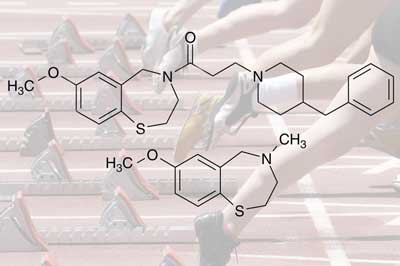
Biochemists at the German Sport University in Cologne have developed an anti-doping test for a drug candidate in early development that may counteract muscle fatigue and potentially enhance athletic performance. They believe that it might already have been used by athletes, possibly in the last summer's Beijing Olympics.
The test can spot benzothiazepine - the core chemical structure of the potential drug candidates JTV519 and S107. These compounds have been tested in mice, but not yet humans, for treating heart abnormalities. A paper published early last year in the Proceedings of the National Academy of Sciences described increased endurance of mice with both drugs.

Benzothiazepine is the core chemical structure of JTV519 (top) and S107 |
'If it works in mice it would also work in humans,' says Mario Thevis, from the university's centre for preventive doping research. He told Chemistry World that after seeing this paper he and colleagues at the university's institute of biochemistry - which is accredited for doping analysis by the International Olympic Committee - decided it would be worthwhile to develop a test to detect the compounds.
The compounds stabilise protein channels that would otherwise 'leak' calcium from muscle cells during strenuous exercise. Calcium is needed for muscle contraction and this 'leaking' effect weakens the contractions and is a causal factor in muscle fatigue.
The first step in developing a new test was to obtain samples of the drugs, whose structures have been published. 'We gave our organic chemistry department the structures and they said, "We can do that for you",' he says. The process is simple, requiring four or five steps and lasting about a week, and could easily be accomplished in an underground doping lab selling to the black market, he adds.
The team characterised the compounds according to weight and molecular structure. With this information, they formulated a molecular 'fingerprint' to detect the compounds at concentrations as low as 0.1 nanograms per millilitre in urine or blood using high resolution mass spectrometry, which Thevis said was their main tool. Details of the team's work were published in the journal Drug Testing and Analysis.
If the World Anti-Doping Agency's (WADA) adds benzothiazepines to its prohibited list, Thevis says his team's test could be tagged onto the existing testing regime used around the world within about 'one day.'
The Beijing Olympics officially were relatively drug free, with only six athletes caught for doping during the games and three other suspected cases identified after the games closed. However, some believe many athletes were using performance-enhancing drugs that could not be detected using standard tests.
Noting that many doping agents used by athletes are drugs developed by pharmaceutical firms for legitimate medical treatments, Thevis says 10 years ago doping tests normally detected only drugs already approved for sale. But as doping prevention officials have intensified efforts to keep tests as up-to-date as possible, cheating athletes and the doping black market have attempted to find drugs earlier in the development process.
Asked whether he believes S107 was used in the Beijing Olympics, Thevis says: 'I cannot exclude that it was used in the Beijing games.'
In an interview with Chemistry World, Olivier Rabin, science director at the WADA, says that S107 'is certainly in our scope of interest.' The drug is, however, still in early development, just entering Phase 1 trials, and is a few years from market this is if it actually makes it to market, he adds.
Normally, but not always, WADA would not seek information from the pharmaceutical firm developing a potential doping drug until Phase 2 trials, he says, adding that the drug is still being formulated in Phase 1 and therefore subject to change.
Referring to S107, he says: 'It is being discussed by the (prohibited) list committee. A decision will be taken as we move along.'
Subscribe to:
Posts (Atom)